
Building a deck is one of the most rewarding upgrades you can make to your home, it extends your living space outdoors and adds real value to your property. But before the first board gets laid, you’re facing a decision that will affect your budget, your weekends, and your deck’s appearance for years to come: composite decking vs wood decking. It’s a choice that trips up a lot of homeowners, and for good reason. Both options have legitimate advantages and real trade-offs that aren’t always obvious at first glance.
At Turning Point Ventures, we’ve built decks across Western Washington using both materials, and we’ve seen how the right choice depends entirely on the homeowner’s priorities. Some clients want the natural warmth of real wood and don’t mind the upkeep. Others prefer a low-maintenance surface that holds up to our wet climate without annual sealing. Neither answer is wrong, but picking the wrong material for your situation can mean unexpected costs or frustration down the road.
This guide breaks down everything you need to know: upfront costs versus long-term investment, maintenance demands, durability in real-world conditions, and the look and feel of each option. By the end, you’ll have a clear picture of which decking material fits your lifestyle, your budget, and your vision for outdoor living.
Why decking material choice matters
Your decking material isn’t just about aesthetics or budget. It’s a decision that affects how you use your outdoor space, how much time you spend maintaining it, and what return you see on your investment when you eventually sell. The wrong choice can mean spending weekends sanding and staining when you’d rather be grilling, or watching your deck deteriorate faster than expected because the material doesn’t match your climate. The right choice, on the other hand, gives you a functional outdoor room that holds up to your lifestyle without constant intervention.
The decision affects your home’s value and function
A deck is one of the few home improvements that delivers measurable return on investment. According to real estate data, outdoor living spaces consistently rank among the top features buyers look for, especially in areas like Western Washington where mild weather extends usable outdoor time. But that value evaporates quickly if your deck looks weathered, splintered, or neglected. Composite decking vs wood decking matters here because composite maintains its appearance longer without intervention, while wood can show its age within a few years if you don’t keep up with maintenance. Buyers notice faded boards, loose nails, and warped planks, and these issues can hurt your appraisal or negotiating position when it’s time to sell.
Beyond resale, you need to consider how you’ll actually use the space. If you’re planning to furnish it with outdoor furniture, host gatherings, or let kids play barefoot, splinters and surface degradation become real concerns. Wood decking can splinter as it ages, especially in high-traffic areas. Composite stays smooth and splinter-free, which makes it safer for bare feet and easier to sweep clean.
Your deck material determines whether you spend your weekends enjoying your outdoor space or maintaining it.
Material choice shapes your lifestyle and time commitment
Some homeowners enjoy the ritual of annual deck care, the satisfaction of applying fresh stain and watching the wood grain come back to life. If that sounds appealing, wood might fit your personality. But if you’d rather spend that time with family or on other projects, composite’s low-maintenance profile makes more sense. The time difference isn’t trivial. Wood decks need cleaning, sanding, and resealing every one to three years depending on climate and sun exposure. That’s a full weekend of work, plus material costs for cleaner, brightener, and sealant.
Composite decking requires a simple wash once or twice a year and nothing more. You’re not locked into a maintenance schedule, and you don’t need to worry about forgetting to seal it before winter. This difference compounds over the deck’s lifespan, potentially saving you dozens of hours and hundreds of dollars in supplies.
Upfront cost vs lifetime cost
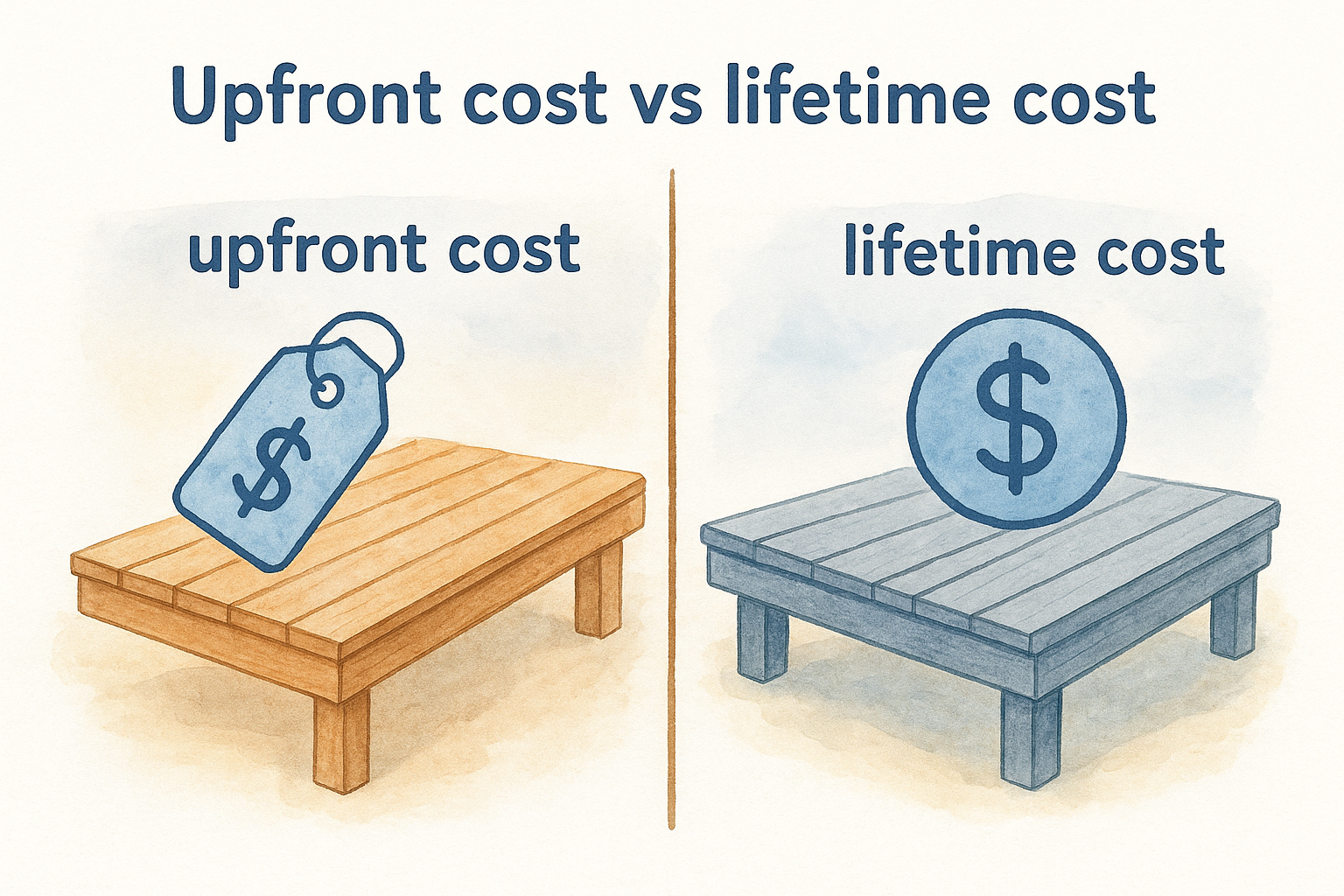
The price tag you see at the lumberyard tells only part of the story. Wood decking costs less initially, which makes it attractive when you’re watching your budget during construction. But that lower entry price comes with ongoing expenses that composite decking avoids almost entirely. Understanding the full financial picture means looking beyond the invoice from your contractor and calculating what you’ll spend over 10, 15, or 20 years of ownership.
What you’ll pay at installation
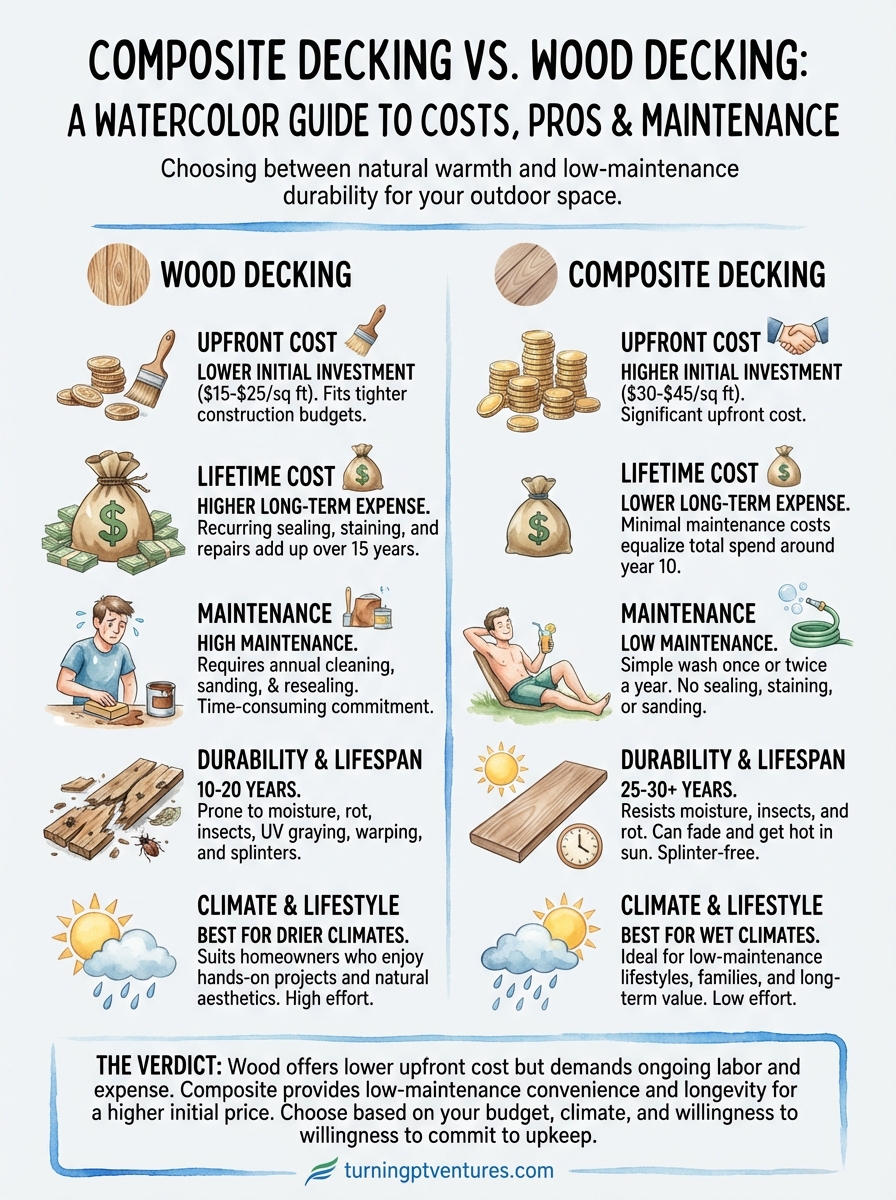
Wood decking typically runs $15 to $25 per square foot installed, depending on the species. Pressure-treated pine sits at the lower end, while cedar and redwood push toward the higher range. Composite decking costs $30 to $45 per square foot installed, roughly double the price of basic wood options. For a 300-square-foot deck, that gap translates to $4,500 to $7,500 for wood versus $9,000 to $13,500 for composite. That difference feels significant when you’re signing the contract.
The cheaper material at purchase often becomes the more expensive choice over time.
The hidden costs that add up over time
Wood requires annual or biennial maintenance that costs $2 to $5 per square foot each time you reseal it, plus your labor if you do it yourself. Over 15 years, that same 300-square-foot deck will need at least five maintenance cycles, adding $3,000 to $7,500 to your total investment. Composite decking vs wood decking shifts dramatically when you factor in these recurring expenses. Composite needs only occasional washing, costing maybe $50 in cleaner annually. By year 10, the total cost of ownership often equalizes, and composite pulls ahead after that. You’re also avoiding the time cost, which many homeowners value more than the money itself.
Durability, lifespan, and common failure points
The deck you build today needs to survive years of weather, foot traffic, and temperature swings without turning into a hazard or an eyesore. Both materials can last decades under the right conditions, but they fail in different ways and at different rates. Understanding these failure patterns helps you set realistic expectations and avoid surprises five or ten years down the road when boards start warping or fading becomes noticeable.
How long each material actually lasts
Wood decking typically lasts 10 to 15 years with proper maintenance, though cedar and redwood can push to 20 years if you’re diligent about sealing. Pressure-treated pine sits at the lower end of that range. Composite decking lasts 25 to 30 years or more with minimal intervention, often outliving the home’s next major renovation cycle. The composite decking vs wood decking comparison becomes stark when you consider replacement timing. You might rebuild a wood deck twice in the time a composite deck lasts once.
Composite decking can outlast wood by a decade or more, making it the better long-term investment for most homeowners.
What causes each material to fail
Wood fails through moisture absorption, UV degradation, and biological attack. Water gets into the grain, causes swelling and shrinking, and eventually leads to rot, especially in boards that stay damp. Insects like carpenter ants and termites target untreated or poorly maintained wood. UV rays break down the lignin in wood cells, turning boards gray and brittle. You’ll see warping, cupping, splitting along the grain, and soft spots where rot takes hold.
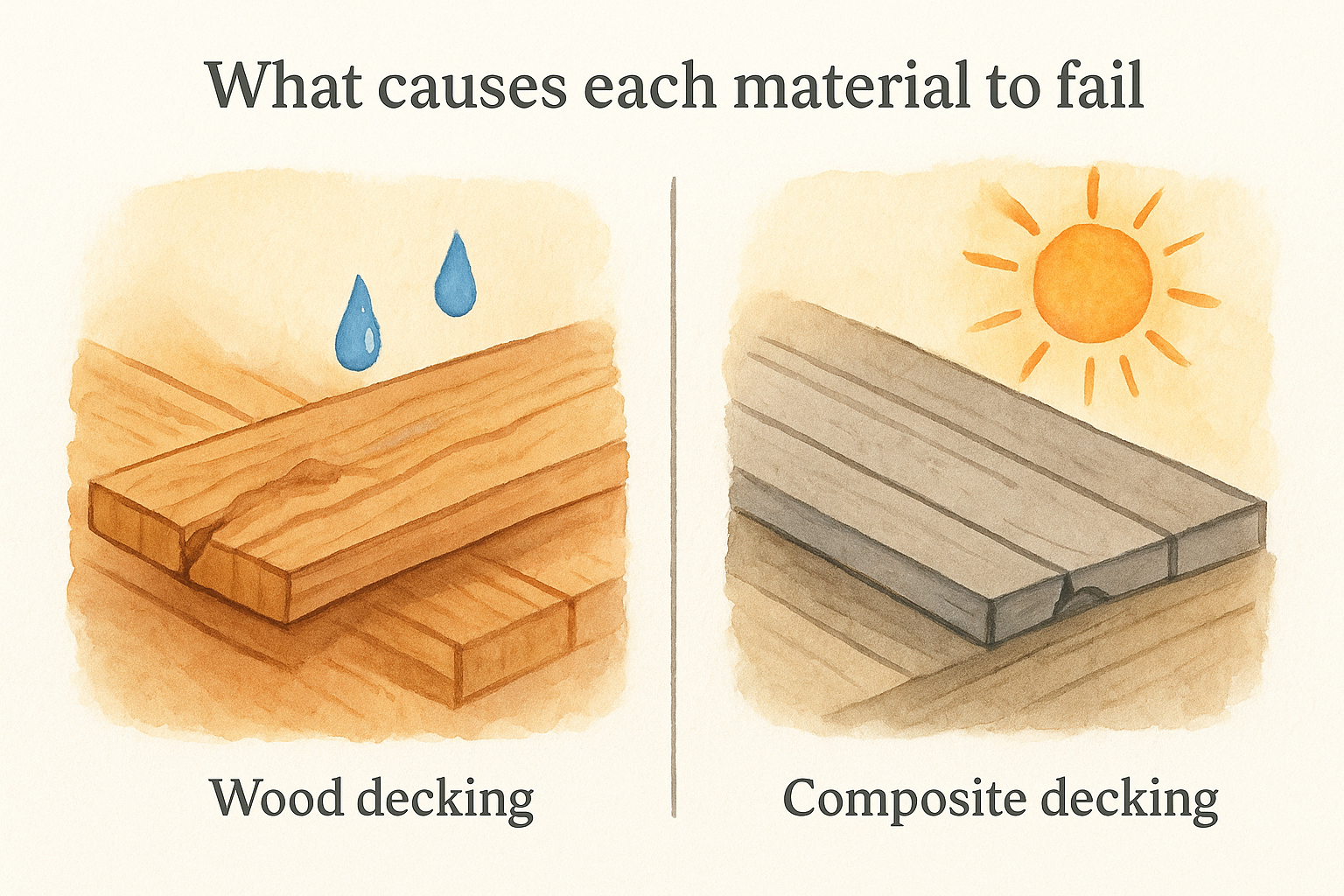
Composite boards resist moisture and insects completely, but they face their own challenges. Heat buildup and fading top the list. Dark composite boards get hot enough in direct sun to be uncomfortable barefoot. Color fading happens over time despite UV inhibitors, though modern formulas have improved significantly. Some cheaper composites experience expansion and contraction that creates gaps or buckling, particularly in extreme temperature swings.
Maintenance, repairs, and day-to-day upkeep
The real test of any deck material shows up in how much time you spend keeping it functional versus how much time you actually get to enjoy it. Maintenance differences between composite and wood become obvious within the first year, and they compound over time. You need to understand what each material demands so you can plan your schedule and budget accordingly, because falling behind on wood deck care accelerates deterioration fast.
What wood decks require
Wood demands consistent attention to stay protected from moisture, sun, and biological threats. You’ll need to clean it thoroughly each spring using a deck cleaner to remove dirt and mildew, then apply a brightener to restore color before sealing. The sealing process itself takes a full weekend for most decks: sanding rough spots, applying two coats of stain or sealant, and waiting for proper drying time between coats. High-traffic areas wear through sealant faster, so you might need spot treatments on stairs or near doorways between full resealing cycles.
Repairs become routine as wood ages. You’ll replace warped or split boards, hammer down popped nails, and address soft spots where moisture penetrated. Each repair means matching wood species and stain color, which gets harder as the existing deck weathers. The ongoing nature of these tasks makes wood the higher-maintenance option by far.
Wood decking requires hands-on care every year, while composite lets you skip the maintenance cycle almost entirely.
What composite decks need
Composite decking simplifies your life dramatically. You’ll wash it once or twice annually with soap and water or a composite-specific cleaner to remove pollen, dirt, and organic stains. That’s typically a one-hour job with a garden hose and scrub brush. Surface scratches from furniture or debris are the main repair concern, though they’re less common than with wood. Some manufacturers offer repair kits for deeper gouges, but most composite surfaces hold up well to normal use without intervention. The composite decking vs wood decking contrast becomes clearest here: one material frees up your weekends while the other demands regular weekend projects to stay in good shape.
How to choose for your home and climate
Your location and personal priorities determine which material makes sense. The composite decking vs wood decking decision isn’t universal, it depends on your specific conditions and what you value most. Some factors matter more than marketing claims or neighbor recommendations, and getting them right means you’ll be happy with your choice years from now instead of second-guessing it after the first winter.
Match material to your climate conditions
Western Washington’s wet climate favors composite decking because it handles constant moisture without rotting or requiring frequent resealing. Wood performs poorly here unless you commit to annual maintenance, since our rain and mild temperatures create ideal conditions for mold and decay. If you live in a drier climate with intense sun, wood might age better with less frequent sealing, though it will still fade and require upkeep. Composite handles sun well but gets hot to the touch in direct exposure, which matters if you plan to walk barefoot. Areas with extreme temperature swings stress both materials, but composite can expand and contract noticeably if you choose a lower-quality product. Snow and ice affect both similarly, though composite’s smooth surface makes it slightly easier to shovel without gouging.
Consider your priorities and lifestyle
Choose wood if you enjoy hands-on projects and want natural warmth underfoot. It makes sense for homeowners who appreciate real wood grain and don’t mind dedicating time to preservation. Pick composite if you value convenience over tradition and want to minimize ongoing tasks. It’s the better choice when you’re planning to stay in your home long-term and want to avoid replacement cycles.
Your daily habits matter more than abstract preferences when choosing a deck material that you’ll live with for decades.
Next steps for your deck project
You now understand the real differences in the composite decking vs wood decking decision: initial costs versus long-term investment, maintenance demands, and durability factors that matter in your specific climate. The right choice depends on whether you prioritize lower upfront costs with ongoing care requirements or higher initial investment with minimal future involvement. Neither material is universally better, but one fits your situation and lifestyle more naturally than the other.
Your next move is to translate this knowledge into action. Walk your property and visualize how you’ll use the space, then consider how much time you’re willing to dedicate to maintenance over the next two decades. If you’re ready to move forward with professional guidance that accounts for Western Washington’s unique conditions, Turning Point Ventures handles both composite and wood deck projects from planning through completion. We help you select the material that matches your goals, then manage every detail so your outdoor space turns out exactly as you envisioned.


0 Comments