
Planning a kitchen renovation means wrestling with one big question: where does all the money actually go? For most homeowners, kitchen remodel labor cost represents the largest chunk of the budget, often more than the materials themselves. Understanding these costs upfront helps you avoid budget surprises and make smarter decisions about where to invest.
At Turning Point Ventures, we’ve managed kitchen renovations across the Puget Sound area and seen firsthand how transparent cost breakdowns give homeowners confidence throughout the project. Whether you’re updating a galley kitchen or gutting a space for a complete transformation, knowing what electricians, plumbers, and carpenters charge, and why, puts you in control of your renovation budget.
This guide breaks down labor rates by trade, explains what percentage of your total budget typically goes to labor, and walks through costs for specific tasks like demolition, cabinet installation, and finish work.
Why labor cost matters in a kitchen remodel
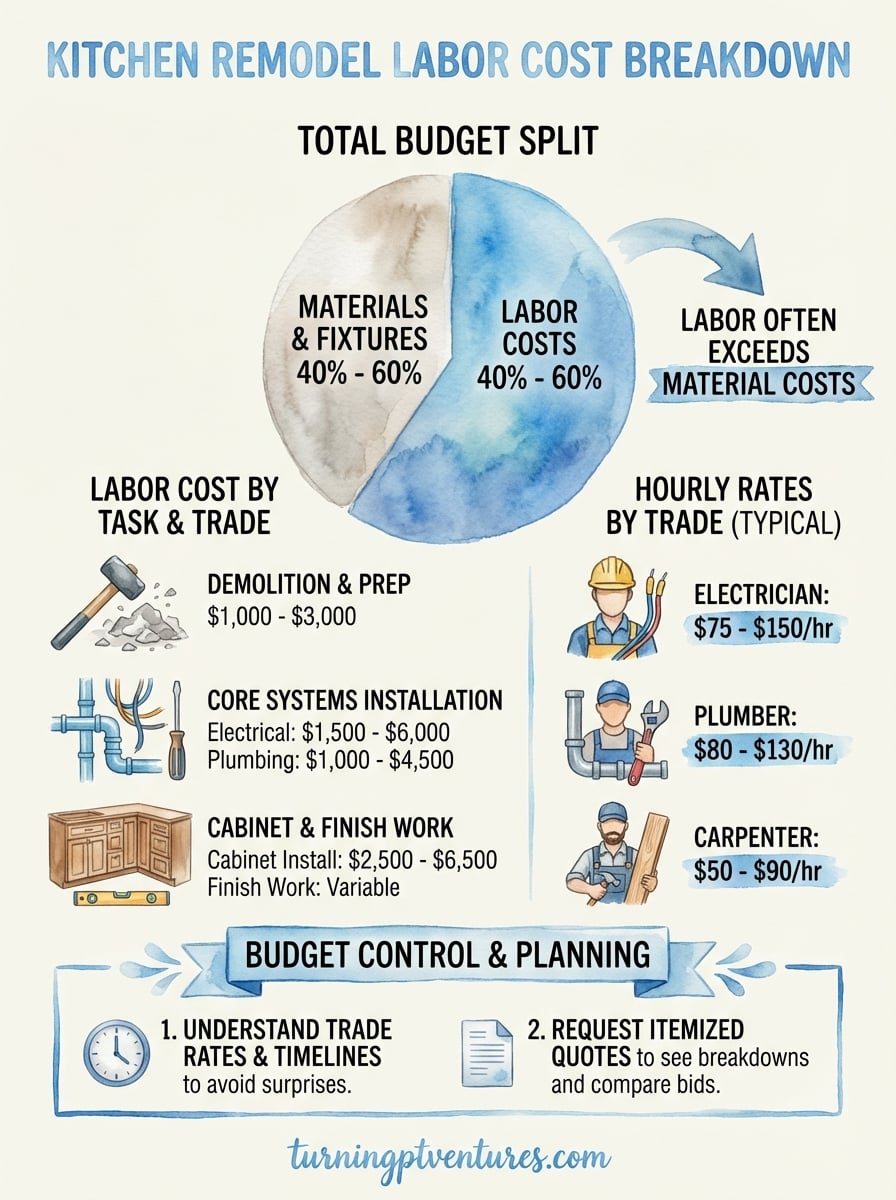
Your kitchen renovation budget splits into two major buckets: materials and labor. While countertops, cabinets, and appliances grab attention when you’re planning, the skilled trades who install everything typically consume 40% to 60% of your total project cost. That means on a $50,000 kitchen remodel, you’re looking at $20,000 to $30,000 going directly to the professionals doing the work.
Labor typically exceeds material costs
Most homeowners underestimate how much kitchen remodel labor cost impacts the final bill. Professional installation protects your investment in expensive materials and ensures work meets building codes. You can buy premium cabinetry for $15,000, but if the installation adds another $3,000 to $5,000, that changes your budget math immediately. Electrical and plumbing work alone can run $2,000 to $8,000 depending on how much you’re changing the layout.
Understanding labor percentages early helps you allocate funds realistically and avoid mid-project cash crunches.
Budget control starts with labor planning
When you know what each trade charges and how long tasks take, you can make informed decisions about scope. Deciding whether to move a sink six feet might seem minor until you realize it adds $1,500 in plumbing labor. Similarly, choosing between refacing existing cabinets versus full replacement becomes clearer when you understand that demolition and installation labor can double the cabinet line item. Contractors who break down labor costs by trade give you the power to adjust plans before work starts, not after you’ve already committed to spending. You can prioritize where skilled labor adds the most value and identify areas where you might save without compromising quality.
Planning around labor costs also helps you schedule realistically. Kitchen renovations take longer than most homeowners expect because multiple trades need to coordinate their work. Knowing that electricians need three days on-site or that tile installation requires a two-day window helps you prepare for the disruption to your daily routine and manage expectations with your family.
What counts as kitchen remodel labor
Kitchen remodel labor cost covers every hour a professional spends working on your project, from the first swing of the demolition hammer to the final adjustment on cabinet doors. This includes skilled trades like electricians, plumbers, and carpenters, plus the general contractor or project manager who coordinates everything. Labor also accounts for the time spent pulling permits, scheduling inspections, and managing the workflow between different trades.
Skilled trades and installation work
The bulk of your labor budget pays for licensed specialists who handle specific systems in your kitchen. Electricians install new circuits, relocate outlets, and wire lighting fixtures. Plumbers reroute water lines, install new drains, and connect appliances like dishwashers and refrigerators with ice makers. Carpenters build custom elements, install cabinets, and handle trim work. Tile setters work on backsplashes and flooring, while countertop fabricators template and install stone or quartz surfaces.
Each trade brings specialized skills that protect your investment and ensure your kitchen meets building codes.
Coordination and project oversight
Beyond hands-on installation, you’re paying for project management that keeps your renovation moving forward. This includes scheduling trades in the correct sequence, ordering materials to arrive when needed, and troubleshooting problems before they derail your timeline. General contractors coordinate inspections with local building departments and handle any adjustments required to pass code review. This oversight prevents costly mistakes and ensures different trades work together smoothly rather than creating conflicts that slow down your project.
Typical labor percentages and rate ranges
Understanding how much of your budget goes to kitchen remodel labor cost helps you plan realistically and compare contractor quotes. Most kitchen renovations allocate 40% to 60% of the total budget to labor, with the remaining portion covering materials, appliances, and fixtures. The exact split depends on how complex your project is and whether you’re keeping the existing layout or moving major systems like plumbing and electrical lines.

Labor as a percentage of total budget
Simple kitchen refreshes with minimal structural changes tend to land at the lower end of the labor percentage, around 40% to 45%. These projects might include replacing cabinets in the same footprint, updating lighting, and installing new countertops. Full gut renovations that involve moving walls, relocating appliances, and upgrading electrical panels push labor costs toward 55% to 60% of your total spend. Projects requiring structural work like removing load-bearing walls or adding square footage can exceed these ranges significantly.
Your project complexity directly determines where you’ll fall within the typical labor percentage range.
Hourly rates by trade
Different trades charge different rates based on their skill level and licensing requirements. General carpenters typically charge $50 to $90 per hour, while licensed electricians run $75 to $150 per hour depending on your region. Plumbers charge similar rates to electricians, usually $80 to $130 per hour. Tile installers bill $40 to $100 per hour, and drywall contractors work in the $50 to $80 per hour range. These rates often increase in urban markets where demand for skilled trades outpaces supply.
Labor cost breakdown by task and trade
Breaking down kitchen remodel labor cost by specific tasks helps you understand where your money goes and how to prioritize spending. Different phases of your renovation require different skill levels and time commitments, which directly affect your labor expenses. Each trade handles distinct responsibilities that build on the previous phase’s work.
Demolition and preparation work
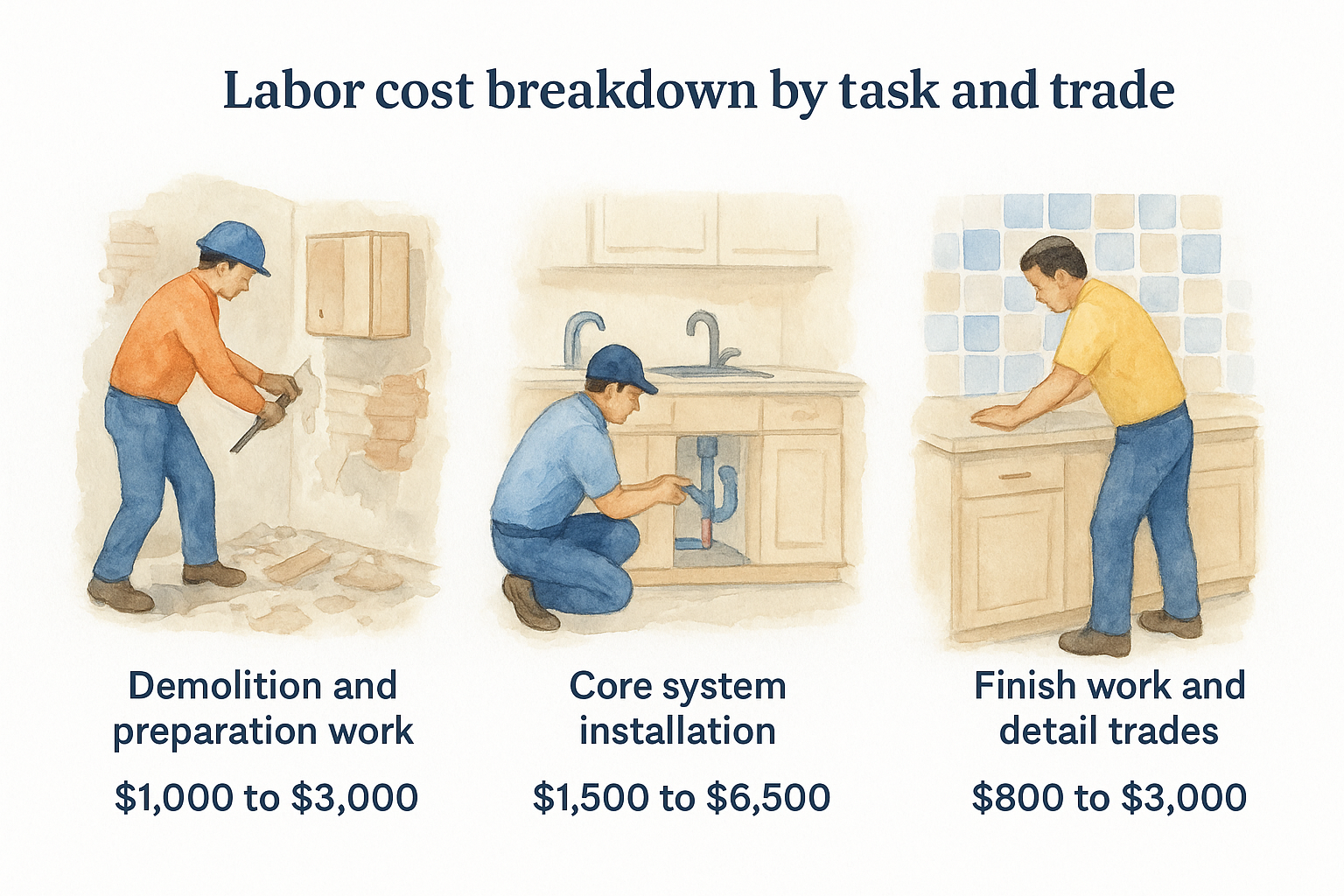
Demolition crews typically charge $1,000 to $3,000 to strip out your old kitchen, depending on how much comes down. This includes removing cabinets, countertops, appliances, and flooring. Structural modifications like opening walls or relocating doorways add $1,500 to $5,000 in carpentry labor. Hauling debris adds another $300 to $800 to your demolition bill.
Core system installation
Electrical work consumes $1,500 to $6,000 of your labor budget for tasks like upgrading circuits, installing under-cabinet lighting, and relocating outlets. Plumbing labor runs $1,000 to $4,500 for new supply lines, drain work, and appliance connections. Cabinet installation typically costs $2,500 to $6,500 depending on your kitchen size and whether you choose stock or custom cabinetry that requires on-site adjustments.
Core trades handle the systems that make your kitchen functional, so budgeting adequately here prevents shortcuts that compromise quality.
Finish work and detail trades
Countertop fabrication and installation add $1,000 to $3,000 in labor, separate from material costs. Tile work for backsplashes ranges $800 to $2,500 depending on pattern complexity and tile size. Flooring installation runs $1,200 to $4,000, while finish carpentry for trim, crown molding, and final adjustments typically costs $800 to $2,000.
How to estimate your kitchen labor cost
Calculating accurate kitchen remodel labor cost starts with understanding your specific project scope and getting detailed breakdowns from contractors. You need more than a single total number because labor costs vary significantly based on what changes you’re making and which trades you’ll need. Start by listing every task your renovation requires, then price each one separately.
Request itemized contractor quotes
Contact at least three licensed contractors and ask for itemized quotes that separate labor from materials. Detailed estimates should list each trade’s work separately, showing what electricians charge versus plumbers or carpenters. This transparency lets you compare apples to apples across different bids and identify where contractors price things differently. Vague lump-sum proposals hide important details that can lead to disputes later.
Itemized quotes give you negotiating power and help you understand exactly what you’re paying for at each project phase.
Build your estimate by trade
List every trade your project needs and estimate their hours based on your kitchen’s size and complexity. Multiply those hours by typical rates in your area, adding 10% to 15% for contingencies. A standard 10×12 kitchen typically needs 40 to 60 hours of carpentry, 16 to 24 hours of electrical work, and 12 to 20 hours of plumbing. Track costs separately for demolition, installation, and finish work so you can adjust scope if your budget gets tight during planning.
Next steps for pricing your kitchen labor
Getting accurate kitchen remodel labor cost estimates requires direct conversations with contractors who understand your specific project. Start by gathering detailed quotes from at least three licensed professionals, making sure each bid breaks down labor by trade and task. Compare the specifics rather than just the bottom line, and ask questions about anything that seems unclear or inconsistent between quotes.
Document your project scope thoroughly before reaching out to contractors. Take photos of your current kitchen, create a list of changes you want to make, and note any structural modifications you’re considering. This preparation helps contractors give you more accurate estimates and reduces the chance of surprise costs emerging mid-project.
At Turning Point Ventures, we provide transparent labor breakdowns and guide homeowners through every decision that affects their budget. Get started on your kitchen renovation with a team that prioritizes clear communication and realistic cost expectations from day one.


0 Comments