
Planning a home addition is exciting until you start researching prices and realize how wildly estimates can vary. Understanding home addition cost per square foot gives you a realistic starting point for budgeting, but that number alone doesn’t tell the whole story. Whether you’re adding a primary suite, expanding your kitchen, or building up a second story, knowing what drives those costs helps you make smarter decisions before breaking ground.
The truth is, square footage pricing shifts dramatically based on what you’re building and where. A basic bump-out costs far less than a fully plumbed bathroom addition or a structural second-floor expansion. Regional labor rates, material choices, and project complexity all factor into your final bill. Without clear benchmarks, it’s easy to underestimate your budget or overspend on features that don’t add proportional value.
At Turning Point Ventures, we walk Western Washington homeowners through these numbers every day as part of our general contracting work. This guide breaks down 2026 cost ranges by addition type, explains why building up versus out affects your bottom line, and gives you the framework to approach your project with confidence.
Why cost per square foot matters for additions
Most homeowners start their addition research by asking "how much will this cost?" and contractors answer with square footage pricing for good reason. Home addition cost per square foot gives you an apples-to-apples comparison framework that strips away the unique details of your property and focuses on core construction economics. Without this metric, you’re comparing wildly different projects with no objective way to evaluate whether a $75,000 bathroom addition is reasonable or inflated.
Square footage pricing also forces clarity about what you’re actually building. A contractor who quotes $200 per square foot for a primary suite addition has made certain assumptions about finishes, systems, and structural work. That baseline number becomes your reference point for every upgrade decision, material swap, and design change you consider. When you understand the per-square-foot cost, you can quickly assess whether adding a vaulted ceiling or upgraded plumbing fixtures will push your budget beyond comfort.
It creates your baseline budget anchor
You need a starting number before you can build a realistic project budget. Square footage pricing establishes that anchor by standardizing how contractors and homeowners communicate about scope. Instead of vague estimates that shift as you refine your vision, the cost per square foot gives you a consistent metric to work from when calculating totals, comparing bids, or deciding whether to scale back your plans.
This approach also helps you spot outliers immediately. If one contractor quotes $150 per square foot for a kitchen addition and another quotes $350, the discrepancy signals that either one is dramatically underestimating complexity or the other is including premium features and finishes you haven’t discussed yet. That gap prompts the right questions before you sign anything.
You can compare project scope realistically
Different addition types carry vastly different per-square-foot costs because of what they require structurally and mechanically. A bump-out that extends an existing room costs less per square foot than a standalone addition that needs its own foundation, exterior walls, and roof integration. When you see cost ranges organized by addition type, you immediately understand why building up costs more than building out or why a second-story addition carries a premium over a ground-floor expansion.
Understanding cost per square foot by addition type prevents sticker shock and helps you choose the right approach for your budget and property layout.
Comparing these ranges side by side also reveals where your money goes. You might assume a two-story addition doubles the cost of a single-story expansion, but the numbers tell a different story because foundation and roofing work doesn’t scale linearly. That insight changes how you evaluate whether vertical or horizontal expansion makes financial sense for your home.
It exposes hidden variables early
Square footage pricing highlights what basic estimates don’t include. A contractor quoting $180 per square foot typically covers standard construction like framing, roofing, electrical, plumbing, and basic finishes, but that number rarely accounts for site prep challenges, permit complications, or high-end material upgrades. When you ask what drives costs above or below the quoted rate, you uncover the variables that actually control your final bill.
This transparency protects you from budget creep. If your property requires soil remediation, significant grading work, or structural reinforcement to support a second story, those costs sit outside the per-square-foot estimate. Knowing that upfront lets you budget appropriately instead of discovering hidden expenses halfway through construction.
2026 cost per square foot ranges by addition type
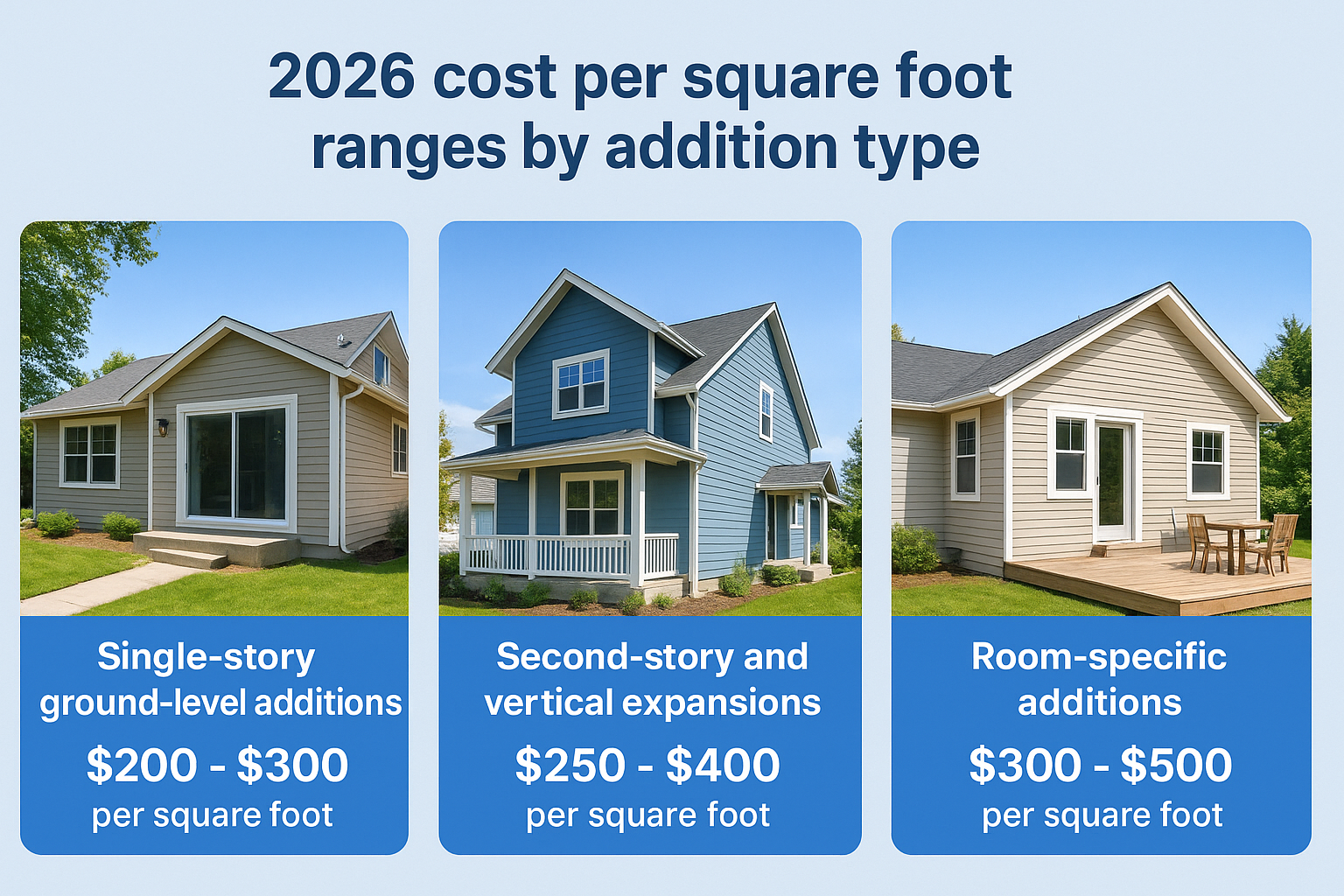
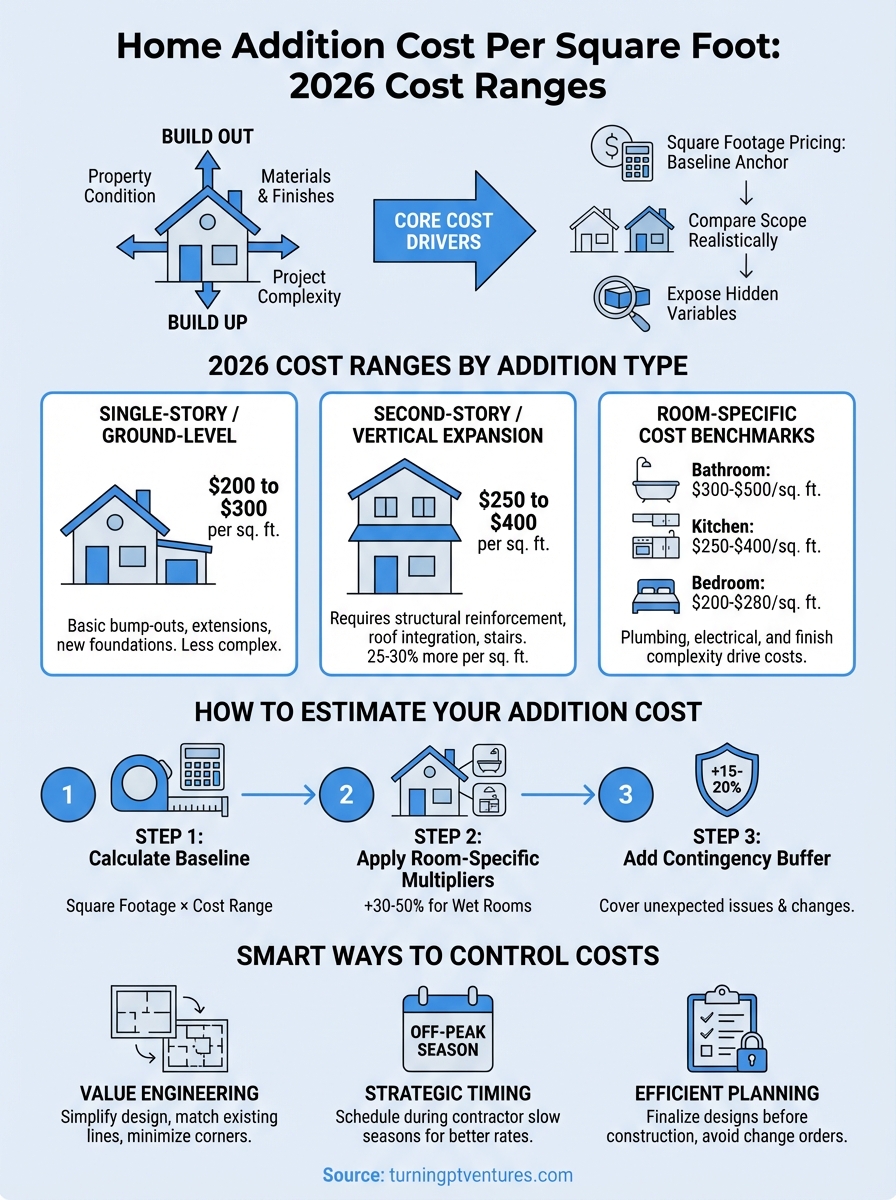
The numbers vary dramatically depending on what you’re building and how it connects to your existing structure. Home addition cost per square foot in 2026 ranges from $150 to $500 across different project types, with most homeowners landing somewhere between $200 and $350 for standard quality construction. These figures include basic materials, labor, permits, and standard finishes, but they shift based on the complexity of integrating new space with your current home.
Single-story ground-level additions
Building outward from your home’s footprint typically costs $200 to $300 per square foot for a standard single-story addition in Western Washington. Basic bump-outs that extend an existing room by 8 to 12 feet fall on the lower end of this range because they use your existing foundation and roof structure for support. Full room additions with new foundations, walls, and roof integration push toward the higher end, especially when you’re adding kitchens or bathrooms that require extensive plumbing and electrical work.
A 400-square-foot family room addition usually runs between $80,000 and $120,000, while a primary suite with a bathroom can reach $140,000 to $180,000 for the same square footage. The difference comes down to mechanical systems, fixtures, and finish complexity rather than raw construction materials.
Second-story and vertical expansions
Adding a second story costs $250 to $400 per square foot because you’re building on top of your existing structure. Your home needs structural reinforcement to support the additional weight, which adds significant engineering and labor costs that ground-level additions avoid. Roof removal, temporary weatherproofing, and staircase integration all contribute to the premium you pay for building up instead of out.
Building up costs 25-30% more per square foot than building out, but you preserve your yard and often gain better views.
A 600-square-foot second-story addition typically costs $150,000 to $240,000, with higher-end finishes and complex structural work pushing toward the upper range. Homes with older framing or foundation issues may require additional investment before vertical construction can even begin.
Room-specific cost benchmarks
Bathroom additions sit at $300 to $500 per square foot because of concentrated plumbing, ventilation, and waterproofing requirements in a small footprint. Kitchen expansions range from $250 to $400 per square foot due to electrical demands, cabinet installation, and appliance integration. Bedroom additions fall between $200 and $280 per square foot since they require less mechanical infrastructure than wet rooms but still need proper insulation, windows, and finished surfaces.
How to estimate your home addition cost
You don’t need a contractor’s quote to get a rough estimate of what your addition will cost. Start with the square footage you want to add, multiply by the appropriate cost range for your addition type, and adjust for complexity factors specific to your project. This calculation gives you a working budget number you can use to decide whether your vision aligns with your financial reality before you invest time in design work or contractor consultations.
Start with your square footage calculation
Measure the space you plan to add and multiply that number by the relevant cost per square foot from the ranges we outlined earlier. A 300-square-foot primary bedroom addition at $240 per square foot gives you a baseline of $72,000. Your actual quote will vary, but this calculation tells you whether you’re thinking about a $60,000 project or a $100,000 one, which matters when you’re evaluating financing options or comparing contractor bids.
Don’t just measure floor space. If you’re building a second story, account for ceiling height requirements and how that affects overall construction volume. Higher ceilings add square footage to your heating, cooling, and finishing costs even though they don’t change your floor measurements.
Factor in room-specific multipliers
Adjust your estimate based on what the space will become. Bathrooms and kitchens cost 30-50% more per square foot than bedrooms or living areas because of plumbing complexity, ventilation requirements, and fixture costs. If you’re adding a 200-square-foot bedroom with a 100-square-foot bathroom, calculate each space separately using the appropriate cost ranges rather than averaging them together.
Room function drives cost more than room size when you’re estimating addition expenses.
Build in a contingency buffer
Add 15-20% to your calculated total to cover unexpected structural issues, design changes, or material price shifts. A project that estimates at $80,000 needs a budget of at least $92,000 to $96,000 to protect you from the surprises that emerge once walls open up or permitting reveals code compliance requirements. Most home addition cost per square foot estimates assume standard conditions, but your specific property may present challenges that only become visible during construction.
What can move your price up or down
The home addition cost per square foot you actually pay depends on variables that exist outside standard estimate ranges. Your specific property conditions, material selections, and structural requirements create cost swings that can push a $200 per square foot project to $280 or drop it to $165. Understanding these factors before you commit to a design helps you anticipate where your budget will land and what tradeoffs you can make to stay within your financial limits.
Foundation and structural complexity
Your existing home’s condition determines how much preparation work you need before new construction begins. Older homes often require foundation reinforcement, framing upgrades, or roof structural modifications that add 15-25% to baseline estimates. If you’re building a second story on a house with inadequate support beams, you’ll pay for engineered solutions that strengthen the entire structure before vertical expansion can proceed safely.
Soil conditions also impact foundation costs significantly. Properties with poor drainage, high clay content, or unstable ground need more extensive excavation and reinforcement than homes built on solid, well-draining soil. A simple slab foundation might cost $8 to $12 per square foot in ideal conditions, but challenging soil can push that to $18 to $25 per square foot when you factor in remediation work.
Material and finish selections
Standard estimates assume mid-grade materials, but your actual choices move costs dramatically. Engineered hardwood flooring costs $6 to $12 per square foot installed, while solid exotic hardwood runs $15 to $25 for the same coverage. Cabinet quality creates similar swings, with stock options starting at $100 per linear foot and custom builds reaching $500 to $1,200 per linear foot depending on wood species and construction methods.
Material upgrades typically add 20-40% to your base construction cost, but they concentrate in kitchens and bathrooms where finish quality matters most.
Window and door selections affect both upfront costs and long-term energy efficiency. Standard vinyl windows cost $300 to $600 installed, while custom wood or fiberglass units run $800 to $1,500 each.
Site accessibility and preparation
Difficult access adds labor time and equipment costs to every phase of construction. Properties with steep slopes, narrow side yards, or limited street access require smaller equipment, more manual labor, and creative material delivery solutions that increase your per-square-foot costs by 10-20%. Contractors charge more when they can’t use standard machinery or need to hand-carry materials to the build site.
Smart ways to keep costs under control
You can reduce your project costs by 15-30% through strategic planning and smart choices that don’t sacrifice quality. Most homeowners focus on cheap materials when they should focus on efficient design, but the real savings come from understanding where your money goes and eliminating waste before construction starts. Budget control starts during planning, not during construction when your options narrow and change orders carry premium pricing.
Value engineering your design
Simplify your floor plan to minimize structural complexity and reduce labor hours. Rectangular additions cost less than L-shaped or curved designs because they require fewer materials, simpler framing, and faster installation. Every corner, angle, or custom detail adds time and expense that compounds across multiple construction phases.
Match your new space to existing ceiling heights and roof lines whenever possible. When your addition ties into your current structure without requiring major modifications, you avoid expensive structural work that inflates home addition cost per square foot beyond standard ranges. Contractors save time when they don’t need to rebuild transitions or engineer complex connections.
Strategic design choices during planning save more money than material downgrades during construction.
Timing and scheduling strategies
Schedule your project during contractor slow seasons, typically late fall through early spring in Western Washington. Contractors offer better rates when they need to keep crews working between peak summer projects, and you get more attention from both the project manager and skilled tradespeople. Material suppliers also run promotions during slower periods that can reduce your overall costs by 5-10%.
Bundle multiple projects into one contract if you’re planning other home improvements. Your contractor can order materials more efficiently, keep crews on site longer, and eliminate mobilization fees that repeat for separate projects.
Working with your contractor efficiently
Make all design decisions before construction starts to avoid change orders that carry 20-40% markups over original estimates. Every modification after work begins costs more because contractors need to undo completed work, reorder materials, and reschedule subcontractors around your changes.
Provide clear site access and designate material staging areas before crews arrive. When contractors can move freely and store materials securely on your property, they complete work faster and reduce labor costs that get passed to you. Simple preparation prevents delays that extend your project timeline and increase your final bill.
Next steps
You now understand how home addition cost per square foot breaks down across different project types and what drives those numbers up or down in 2026. Armed with these benchmarks, you can calculate realistic budget estimates, evaluate contractor quotes with confidence, and make informed decisions about whether to build up or out based on your financial constraints and property layout.
Start by measuring your proposed addition space and applying the appropriate cost range from this guide. Build in your contingency buffer, then prioritize which features matter most to your household. If your numbers align with your budget, schedule consultations with local contractors who can assess your specific property conditions and provide detailed estimates that account for structural requirements and site challenges.
Ready to transform your vision into a construction plan? Explore our services to see how Turning Point Ventures manages home addition projects from initial design through final inspection, handling all the complexity while you focus on the exciting parts of expanding your living space.


0 Comments