
You’ve picked out the countertops, sketched the layout, and maybe even saved a folder full of inspiration photos. Then the estimates come in, and suddenly the excitement hits a wall. A kitchen remodel can run anywhere from $20,000 to well over $80,000 depending on scope, materials, and where you live, and most people don’t have that kind of cash sitting in a checking account. That’s where understanding your kitchen remodel financing options becomes just as important as choosing the right backsplash.
At Turning Point Ventures, we manage kitchen renovations across the Puget Sound area from first sketch to final walkthrough. One thing we see repeatedly: homeowners who are ready to start but unsure how to pay for it. Financing isn’t a backup plan, for many of our clients, it’s the strategy that makes their dream kitchen possible without draining savings or delaying the project for years. We talk about budgets early and often because how you fund the work shapes every decision that follows, from material selections to project phasing.
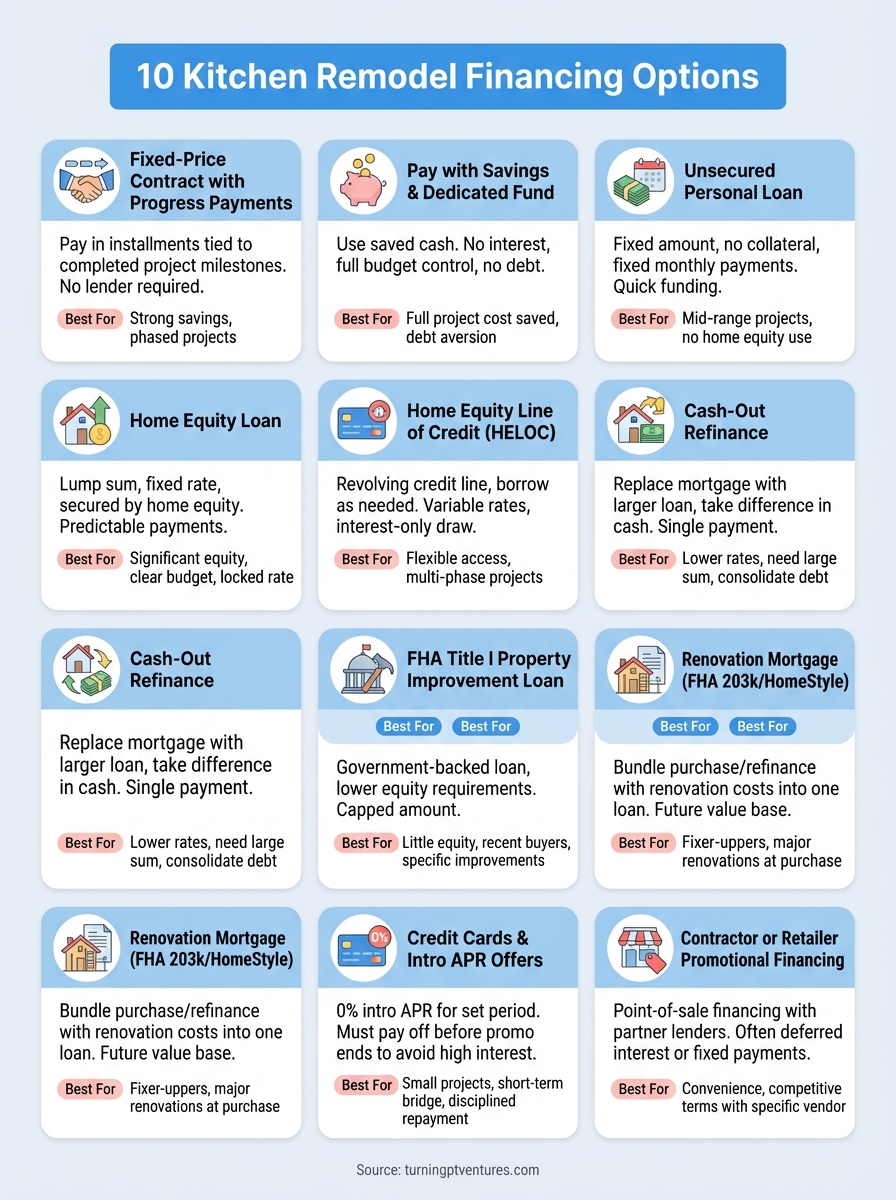
This guide breaks down ten practical ways to finance your kitchen remodel, including personal loans, HELOCs, cash-out refinancing, contractor financing, and a few options you might not have considered. We’ll cover how each one works, what it costs, and who it’s best suited for, so you can pick the path that actually fits your financial situation. No jargon, no pressure, just a clear comparison to help you move forward with confidence.
1. Fixed-Price Contract with Progress Payments
Before exploring loans and credit lines, it’s worth understanding one kitchen remodel financing option that doesn’t require a lender at all. A fixed-price contract with progress payments is an agreement between you and your contractor that locks in the total project cost upfront and spreads your payments across defined milestones rather than demanding everything at the start or the end.

How It Works
Your contractor provides a detailed scope of work and a firm total price before any demolition begins. You then pay in installments tied to specific project milestones, such as after demolition, after rough-in work passes inspection, after cabinets are set, and at final completion. Each payment releases funds for the next phase of work.
This structure keeps both parties accountable. You’re not handing over large sums before work is done, and your contractor has a predictable cash flow to keep the project moving without delays caused by funding gaps.
When It Makes Sense
This approach works best when you have savings distributed across several months or access to a credit line you can draw from in stages rather than all at once. It’s also a strong fit if you’re working with a general contractor who manages subcontractors and materials directly. If you’re funding your remodel through a HELOC or construction loan, the draw schedules in those products align naturally with milestone-based payment structures, making coordination between your lender and contractor straightforward.
Costs and Terms to Expect
A fixed-price contract means no surprise invoices for labor fluctuations or minor material cost swings; those risks fall on the contractor. Here’s what a typical payment breakdown looks like:
| Payment Stage | Typical Percentage |
|---|---|
| Signing / mobilization | 10% to 20% |
| Demolition and rough-in complete | 20% to 25% |
| Cabinets, plumbing, electrical rough-in | 25% to 30% |
| Final completion and punch list | 25% to 30% |
Some contractors build a small contingency buffer into their fixed price. That’s standard practice, not a red flag, and it protects both sides from minor material price changes.
What to Confirm in Your Contract
Read the payment schedule line by line before signing. Confirm that each payment is tied to a specific, verifiable milestone rather than a time-based schedule like "week three." Also verify that the contract includes a written change order process requiring your approval before any additional costs are added, no matter how small.
A fixed-price contract only protects your budget when it’s paired with a detailed written scope that defines exactly what’s included and what isn’t.
Key items to confirm before signing:
- Payment amounts and triggering milestones listed explicitly
- Change order clause requiring your written sign-off before work begins
- Lien waiver requirements at each payment stage
- Dispute resolution process if work quality is contested
Pitfalls to Avoid
The biggest risk is letting payments run ahead of completed work. Never release the next payment early, even if your contractor says they need funds to lock in a subcontractor. A second common problem is signing a contract with vague milestone descriptions like "rough work complete" without specifying what that means in measurable terms. Ask your contractor to define each milestone clearly enough that anyone walking the job site could confirm independently that the work is done.
2. Pay with Savings and a Dedicated Remodel Fund
Paying cash is the simplest of all kitchen remodel financing options because it eliminates lender approvals, interest charges, and monthly payments. If you have the funds available or can build toward them, this approach gives you full control over your budget and timeline from day one.
How It Works
You set aside a specific sum in a dedicated account separate from your everyday finances before the project starts. As your contractor hits milestones, you pull directly from that fund. Keeping the money separated prevents you from accidentally spending it and gives you a clear picture of exactly how much you have left at any point during the remodel.
When It Makes Sense
This approach fits best when your total project cost falls within reach of what you’ve already saved or can realistically accumulate in six to eighteen months. It also makes sense if you want to avoid debt entirely or if your credit profile would result in high interest rates on a loan.
Costs and Terms to Expect
Paying with savings carries no interest, no origination fees, and no closing costs. The only real cost is the opportunity cost of money sitting in a savings account rather than an investment account. A high-yield savings account can reduce that gap while keeping your funds liquid and accessible when milestone payments come due.
The true cost of cash financing is what that money could have earned elsewhere, so park it somewhere with a competitive rate while you finalize your project plans.
How to Protect Your Emergency Fund
Never pull from your emergency reserve to cover remodel costs. Keep three to six months of living expenses completely untouched in a separate account. Build your remodel fund independently so that a mid-project surprise, like a pipe behind the wall that needs replacing, doesn’t leave you unable to cover an unrelated financial emergency.
Pitfalls to Avoid
The most common mistake is underestimating the total project cost and depleting the fund before work finishes. Build in a 10% to 15% contingency on top of your contractor’s fixed price so that change orders or unforeseen conditions don’t stall the project mid-stream.
3. Unsecured Personal Loan
An unsecured personal loan is one of the most straightforward kitchen remodel financing options available because it requires no collateral and no home appraisal. You borrow a fixed amount, receive it as a lump sum, and repay it in equal monthly installments over a set term, typically two to seven years.
How It Works
You apply through a bank, credit union, or online lender, and they evaluate your credit score, income, and existing debt to determine whether to approve you and at what rate. If approved, the funds land in your account within a few days. From there, you pay your contractor directly according to your agreed milestone schedule.
When It Makes Sense
A personal loan works well when you don’t have significant home equity or when you want to keep your mortgage untouched. It’s also a reasonable fit for mid-range kitchen projects in the $10,000 to $40,000 range where borrowing against your home feels disproportionate to the project size.
Personal loans are best suited for homeowners who need fast funding and a predictable monthly payment without touching their home’s equity position.
Costs and Terms to Expect
Interest rates on unsecured personal loans vary widely based on your credit profile. Here’s a general reference range:
| Credit Score Range | Typical APR Range |
|---|---|
| 760 and above | 7% to 12% |
| 700 to 759 | 12% to 18% |
| 640 to 699 | 18% to 28% |
| Below 640 | 28% or higher |
Origination fees typically run 1% to 8% of the loan amount and are often deducted from your disbursement, so borrow slightly more than your project cost if your lender charges them.
What Lenders Look For
Lenders focus primarily on your debt-to-income ratio and credit score. Most lenders want your total monthly debt payments, including the new loan, to stay below 40% of your gross monthly income. A strong payment history and low credit utilization will get you the best rates.
Pitfalls to Avoid
The most common problem is borrowing based on the monthly payment rather than the total cost. A longer repayment term lowers your monthly bill but significantly increases what you pay overall. Run the full cost calculation before signing, and choose the shortest term your budget can support to minimize total interest paid.
4. Home Equity Loan
A home equity loan lets you borrow against the value you’ve built in your property as a single lump-sum disbursement at a fixed interest rate. It’s one of the more structured kitchen remodel financing options available because your rate and monthly payment stay the same from the first payment to the last.

How It Works
Your lender appraises your home to establish its current market value, then subtracts your outstanding mortgage balance to calculate your available equity. Most lenders will let you borrow up to 80% to 85% of your home’s appraised value minus what you still owe. The loan funds arrive in one transfer, and you repay the full balance in fixed monthly installments over a term typically ranging from five to twenty years.
When It Makes Sense
This option suits homeowners who have owned their property long enough to accumulate meaningful equity and who know their total project cost upfront. Because you receive all the funds at once, it works best when your remodel has a clearly scoped, fixed budget rather than a phased or evolving plan where you might not need all the money immediately.
A home equity loan is a strong fit when you want a locked-in rate and a clear payoff date rather than an open-ended line of credit.
Costs and Terms to Expect
Rates on home equity loans are typically lower than personal loans because your home secures the debt. Expect closing costs between 2% and 5% of the loan amount, covering appraisal fees, title search, and origination charges. Current rates generally range from 7% to 10% depending on your credit profile and the lender.
What Lenders Look For
Lenders focus on your combined loan-to-value ratio and credit score. Most want a credit score of at least 680 and a debt-to-income ratio below 43%. You’ll also need documentation of income, recent tax returns, and a current mortgage statement to verify your existing balance.
Pitfalls to Avoid
The most serious risk is that your home serves as collateral, meaning missed payments can lead to foreclosure. Never borrow more than you need for the project, and confirm your monthly payment fits your budget before the appraisal fee clears your account.
5. Home Equity Line of Credit
A home equity line of credit, or HELOC, gives you revolving access to cash drawn from your home’s equity rather than a single lump-sum disbursement. Unlike the home equity loan covered in the previous section, a HELOC works more like a credit card secured by your home, letting you borrow what you need, repay it, and borrow again during the draw period.
How It Works
A HELOC has two phases. During the draw period, which typically runs five to ten years, you can borrow up to your approved credit limit as needed and usually pay interest only on the amount drawn. Once the repayment period begins, you can no longer pull funds and must pay back both principal and interest, typically over ten to twenty years.
When It Makes Sense
A HELOC is one of the more flexible kitchen remodel financing options because it matches how construction projects actually move. Costs don’t arrive all at once, and a HELOC lets you draw funds as each milestone payment comes due rather than borrowing a large lump sum upfront and paying interest on money you haven’t spent yet.
A HELOC works especially well when your project has multiple phases or when you want a financial cushion available without paying interest until you actually draw on it.
Costs and Terms to Expect
Most HELOCs carry variable interest rates tied to the prime rate, which means your payment can change as rates move. Closing costs typically run 2% to 5% of the credit limit, though some lenders waive them if you keep the line open for a minimum period, usually two to three years.
What Lenders Look For
Lenders review your credit score, debt-to-income ratio, and combined loan-to-value ratio. Most require a credit score of at least 680 and enough equity to keep your combined borrowing below 85% of your home’s appraised value.
Pitfalls to Avoid
The biggest risk is variable rate exposure during a period of rising interest rates. Your draw-period payment can look manageable at signing but increase significantly before repayment begins. Set a personal borrowing cap well below your approved limit so a rate increase doesn’t push your budget past its breaking point.
6. Cash-Out Refinance
A cash-out refinance replaces your existing mortgage with a new, larger loan and gives you the difference in cash at closing. Among kitchen remodel financing options, this one gives you access to the largest sums possible because you’re borrowing against your entire home value rather than just a portion of your equity.

How It Works
You apply for a new mortgage that exceeds your current loan balance, and your lender pays off the old mortgage first. You receive the remaining funds as a lump sum to use for your kitchen project. Your existing loan disappears and is replaced by the new one with its own rate, term, and monthly payment.
When It Makes Sense
This option fits best when current mortgage rates are near or below what you already pay, or when you need more cash than a home equity loan or HELOC can provide. It also makes sense if you want to consolidate your borrowing into a single monthly payment rather than managing a mortgage alongside a separate home equity product.
A cash-out refinance is most valuable when it simultaneously lowers your rate and gives you the funds you need, not when it trades a low rate for a higher one just to access cash.
Costs and Terms to Expect
Closing costs on a cash-out refinance typically run 2% to 6% of the new loan amount, which is substantially higher than a HELOC or home equity loan. Most lenders limit your cash-out to 80% of your home’s appraised value minus your existing mortgage balance, so your available funds depend directly on how much equity you’ve built.
What Lenders Look For
Lenders require a credit score of at least 620, though the best rates go to borrowers at 740 and above. They also verify your debt-to-income ratio stays below 45%, review two years of tax returns, and require a full appraisal to confirm current market value.
Pitfalls to Avoid
The biggest risk is stretching your loan term back out to 30 years when you were already years into repayment. That resets your amortization schedule and increases total interest paid over the life of the loan, even if your monthly payment looks similar to what it was before.
7. FHA Title I Property Improvement Loan
The FHA Title I property improvement loan is one of the least-known kitchen remodel financing options available, yet it fills a real gap for homeowners who have little equity built up. The federal government backs these loans through the Department of Housing and Urban Development, which allows approved lenders to offer them at lower risk, making approval more accessible for borrowers who wouldn’t qualify for equity-based products.
How It Works
An FHA-approved lender issues the loan directly to you, and the federal government insures it against default. For loans at or below $7,500, no collateral is required, which means you don’t need to pledge your home to secure the funds. Loans above that threshold are secured by your property, but you still don’t need significant equity the way you would with a home equity loan or HELOC.
When It Makes Sense
This option is a strong fit if you purchased your home recently and haven’t accumulated enough equity to qualify for other secured products. It also works well for homeowners in flat or slow-appreciating markets where equity growth has been modest. The loan is specifically designed for improvements that protect or improve the livability of the home, and a kitchen remodel clearly qualifies.
An FHA Title I loan is worth pursuing if other equity-based options are out of reach but you still want a government-backed product with regulated terms.
Costs and Terms to Expect
Loan amounts for single-family homes go up to $25,000, with repayment terms up to 20 years for secured loans and up to 12 years for unsecured ones. Interest rates are fixed and set by the individual lender, but they typically run higher than home equity loans because the government insurance only partially offsets lender risk.
What Lenders Look For
Approved lenders check your credit history and income stability rather than your equity position for smaller loans. Most lenders want a reasonable payment history and confirmation that your debt-to-income ratio stays manageable with the new payment added.
Pitfalls to Avoid
The main limitation is the $25,000 borrowing cap, which can fall short for a full kitchen renovation in higher-cost markets. Confirm your total project budget against this ceiling before committing to the application process.
8. Renovation Mortgage Like FHA 203k or HomeStyle
A renovation mortgage bundles your home purchase price and renovation costs into a single loan, so you don’t need existing equity before the work begins. Two products dominate this space: the FHA 203(k), backed by the federal government, and the Fannie Mae HomeStyle loan, a conventional alternative. Both treat your renovation as part of the original financing rather than a separate borrowing event.

How It Works
You apply for the mortgage before construction starts, submitting contractor bids and detailed project plans to establish the total loan amount. An appraiser then evaluates what your home will be worth after the improvements are complete, and that post-renovation value determines your borrowing capacity. Renovation funds are held in escrow and released to your contractor in draws as each phase is inspected and verified.
When It Makes Sense
This is one of the most useful kitchen remodel financing options for buyers purchasing a property that needs significant updates before it suits their needs. It also works well for existing homeowners who want to refinance and roll renovation costs into a new mortgage rather than layering a separate loan on top.
A renovation mortgage works best when you’re buying a fixer-upper or refinancing an existing home, not when you already have strong equity and want a faster, simpler product.
Costs and Terms to Expect
| Product | Minimum Down | Mortgage Insurance | Loan Term |
|---|---|---|---|
| FHA 203(k) | 3.5% | Required (upfront + annual) | 15 or 30 years |
| Fannie Mae HomeStyle | 3% | Not required above 20% equity | 15 or 30 years |
Both products carry standard long-term repayment structures, and renovation amounts must meet minimums set by the lender, typically at least $5,000 in improvements for the FHA 203(k).
What Lenders and Appraisers Require
Lenders require detailed contractor bids and a full project scope before approving the loan, and appraisers rely on those documents to calculate after-renovation value. Most standard FHA 203(k) loans also require a HUD-approved 203(k) consultant to manage draw requests and verify completed work at each milestone.
Pitfalls to Avoid
The approval process is significantly more document-intensive than a personal loan or HELOC, and timelines from application to closing often run six to eight weeks or longer. Selecting a contractor unfamiliar with renovation mortgage draw schedules is one of the most common ways to stall a project after funding is in place.
9. Credit Cards and Intro APR Offers
Credit cards rarely top the list when homeowners research kitchen remodel financing options, but a well-timed intro APR offer can cover smaller scopes without costing a dollar in interest if you pay the balance off before the promotional period expires.
How It Works
When a card issuer approves you for a new account, they often include a 0% introductory APR on purchases for a set period, commonly 12 to 21 months. You charge renovation costs to the card, make minimum payments during the promo window, and pay the remaining balance before the period ends. Any balance still open when the promo expires begins accruing interest at the card’s standard rate, which can run significantly higher than other loan products.
When It Makes Sense
This approach works best for smaller kitchen updates in the $3,000 to $10,000 range where you have a realistic plan to pay the balance within the promotional window. It also fits situations where you need to bridge a short funding gap while waiting for a home equity or personal loan to close.
A 0% intro APR card is essentially a free short-term loan, but only if you treat the promo expiration date as a hard payoff deadline.
Costs and Terms to Expect
Intro periods typically run 12 to 21 months, after which standard APRs often jump to 20% or higher. Most cards also charge a balance transfer fee of 3% to 5% if you move debt from another card. There are no closing costs or origination fees, which keeps the upfront cost lower than most loan products.
How to Use Cards Without Derailing Your Budget
Track every charge against a written payoff schedule that divides your total balance by the number of months remaining in the promo period. Set up automatic monthly payments to hit that target amount rather than the minimum, which will not clear your balance in time. Keep your overall credit utilization below 30% across all cards to avoid a significant drop to your credit score during the project.
Pitfalls to Avoid
The biggest risk is misjudging your payoff timeline. Contractors sometimes encounter hidden conditions that add costs mid-project, and a single change order can push your total past what you planned to retire before the promotional rate expires. Build a 10% to 15% buffer into your payoff plan before the first charge hits the card.
10. Contractor or Retailer Promotional Financing
Contractor or retailer promotional financing puts a credit line or installment loan directly in front of you at the point of sale, often through a third-party lender the business has partnered with. It’s one of the more convenient kitchen remodel financing options because the application happens in the same conversation as your project quote or product selection, with no separate trip to a bank required.
How It Works
The contractor or retailer works with a lending partner to offer you financing through a branded or co-branded credit account. You apply on the spot, the lender runs a credit check, and approval often comes within minutes. Funds are either disbursed directly to the contractor or charged against the credit line as work progresses. Some programs offer deferred interest or fixed monthly payment plans structured over 12 to 60 months.
When It Makes Sense
This option works well when you’re already committed to a specific contractor or supplier and the financing terms are competitive with what you’d find on your own. It can also close a gap quickly when you need to lock in a project start date and don’t have time to complete a full loan application through a separate lender.
Costs and Terms to Expect
Terms vary widely depending on the lending partner behind the program. Promotional periods with reduced or deferred interest typically run 6 to 24 months, and standard APRs after the promo window often land between 18% and 30%. Some programs charge no interest if the balance is paid in full before the promotional period ends, but deferred interest products retroactively charge all interest from day one if any balance remains.
What to Ask Before You Sign
Read the fine print on deferred interest offers before you agree to anything, because a remaining balance of even one dollar can trigger the full retroactive interest charge.
Ask your contractor or retailer to confirm whether the offer is "no interest" or "deferred interest" because those two terms are not the same. Also confirm the standard APR, the monthly payment required to pay off the balance within the promo window, and whether early payoff carries any penalties.
Pitfalls to Avoid
The most common mistake is treating a low monthly payment as a sign of affordability without calculating the total cost once the promotional period expires. Many borrowers also assume their contractor’s financing is the best deal available when a personal loan or HELOC could offer a lower rate with no retroactive interest risk. Always compare at least one outside offer before committing.
Next Steps for Funding Your Remodel
You now have a clear picture of the ten kitchen remodel financing options available to you, from milestone-based cash payments to renovation mortgages. The right choice depends on how much equity you hold, how quickly you need funds, and how much monthly payment flexibility your budget can absorb. If you’re still unsure where to start, compare at least two options side by side using your actual project estimate, not a rough guess, so your numbers reflect reality.
Choosing how to fund your project is only half the equation. The other half is working with a contractor who manages your budget transparently and keeps the project on schedule so your financing doesn’t outlast the work. At Turning Point Ventures, we walk you through both sides of that equation from day one. When you’re ready to move forward, start a conversation with our team and we’ll help turn your plan into a project.


0 Comments